
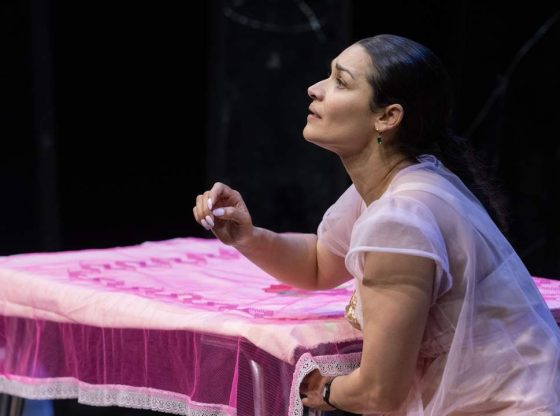

In marking the centenary of Italian satirist Dario Fo, taking on ‘A Woman Alone’ – co-written with Franca Rame – demands an artist willing to walk a razor-thin tightrope between sheer farce and suffocating domestic horror. Staged at Suidoosterfees and Woordfees and directed by Quanita Adams, this distinctly South Africanised adaptation finds its beating heart in a bravura, full-tilt performance by Kim Engelbrecht. She grabs the piece by the collar and turns an apartment prison into a kinetic arena of tragicomedy.
From the opening beat, the production leans into retro-styled production values, enveloping the staging in a heightened, vintage domestic aesthetic that feels simultaneously nostalgic and uncomfortably claustrophobic. Locked inside an apartment by an intensely controlling, abusive husband, Engelbrecht’s character is trapped in an ecosystem of total dysfunction. Outside, peeping toms lurk; inside, an obscene telephone caller rings incessantly and a severely incapacitated brother-in-law demands care. Caught in this domestic crossfire, she scrambles frantically to maintain some semblance of normalcy in her fractured identity as wife, mother and secret lover.
Rather than sinking under the sheer misery of the premise, the production chooses relentless energy. Engelbrecht delivers an intensely physical, heightened lead performance, adopting a clownish, almost commedia dell’arte disposition. She dives headfirst into slapstick routines, exaggerated physical comedy and frantic confessional patter to the unseen neighbour across the courtyard. Her vitality on stage is magnetic – she dashes, contorts and schemes with cartoonish momentum, refusing to let the character collapse into passive victimhood.
This collision of bleak reality and manic levity inevitably recalls Roberto Benigni’s ‘Life is Beautiful’. Much like Benigni constructing elaborate, absurd games to shield his son from the horrors of a concentration camp, Engelbrecht’s protagonist weaponises farce as a psychological survival mechanism. Comedy is forged not in spite of the darkness, but directly out of it.
Yet that very choice makes the tone inherently tricky to navigate. Watching ‘A Woman Alone’ can be an unsettling experience: you find yourself roaring with laughter at a sharp punchline or a frantic physical bit, only to be struck immediately by the sickening realisation of just how desperate and abusive her reality is. That discomfort – the awkward friction of laughing in the middle of a deeply sad, violent situation – is precisely where Fo and Rame’s satire does its sharpest work. Engelbrecht’s buoyant, clownish warmth makes the audience complicit; we laugh with her manic optimism right until the tragedy catches in the throat.
By grounding this classic piece of feminist Italian satire in a recognisable local cadence, the production proves that Dario Fo’s century-old theatrical principles remain as vital and disquieting as ever. Engelbrecht doesn’t just play the role; she supercharges it to the point of standing ovation, delivering an evening of high-octane theatre that is as uproariously entertaining as it is quietly devastating.